Once a spring is mined, it doesn't come back: voices from the Progo sub-basin
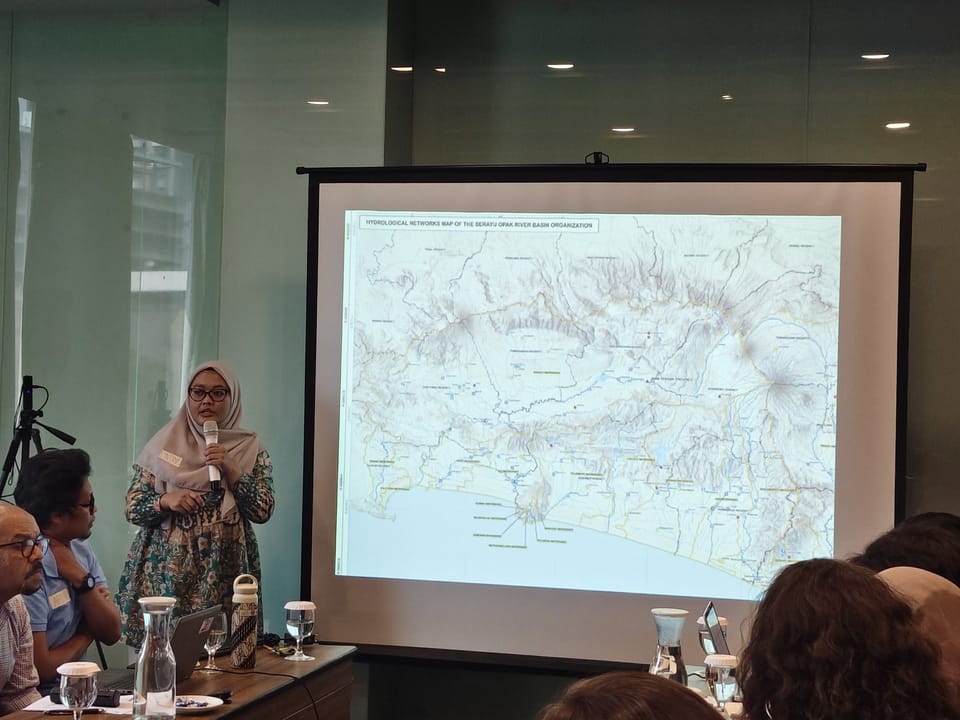
Among the many themes raised on Day 2 of the workshop, one carried a different weight from the others. It was not a modelling problem, not an institutional fragmentation problem, not a data-synchronisation problem. It was a simple, concrete, and ongoing loss. Galian C mining — the extraction of sand, stone, and gravel from rivers and riverbeds — is progressively deepening river channels, severing surface water flow paths, and ultimately killing natural springs. And once a spring is lost, it does not return.
"The toughest challenge for us is probably in Progo — once a spring zone gets mined, the spring disappears, because the mining keeps going deeper and deeper." — paraphrased, Bappeda DI Yogyakarta participant
The Progo sub-basin sits at the heart of this concern. The numbers from the BBWS-SO basin profile are large: an estimated 851 springs across the basin, 1,492 BJP springs, and 250 wells, alongside seven underground rivers in the Gunungkidul karst plateau. That inventory is part of what makes the basin a credible pilot. It is also part of what makes the risk so painful. A basin can lose a great deal of its hydrogeological character not in a generation but in a few years if the spring zones remain unprotected.
Participants were direct about what they expect from the project. They are not asking the consortium to draw additional hydrogeological maps for their own sake. Maps already exist; agencies have versions of them. What participants asked for is a practical recommendation that names locations: which spring zones need a moratorium on Galian C activity, what conditions should be attached to existing mining permits in identified sensitive areas, and what recovery mechanisms exist for springs that can still be saved before they pass a threshold of recovery.
Three points of context shape this ask.
The first is that this is a permitting problem, not a scientific gap. Galian C activity is regulated. Permits are issued. The challenge is that the permitting process does not currently weight hydrogeological vulnerability strongly enough — which is to say, the river-bed material is treated as a quarryable resource rather than as a piece of the spring ecosystem above it. Better data alone will not fix this. The data needs a permitting interface.
The second is that recovery is asymmetric. Many ecological systems can be impaired and then restored if pressure is removed. Springs are different. Once mining lowers a riverbed past the level at which groundwater intersects the surface, the spring loses its emergence point. The aquifer may still be there, but the spring — as a usable surface feature — is gone. There is no rehabilitation plan that brings it back.
The third is that the basin still has time. The discussion did not adopt a tone of resignation. Participants framed the request as urgent, not lost. The project's groundwater-baseline deliverable, led by UGM's Department of Geological Engineering, is scheduled for September 2026, and the team has committed to mapping priority wells, springs, and recharge zones — including those currently most vulnerable to Galian C activity. The mapping is intended to be operational from the start: explicit categories, explicit recommendations, and a clear handoff to the agencies that issue permits.
There is also a connection to the basin's existing monitoring capacity. The Yogyakarta-Sleman groundwater basin already operates around fifty-four monitoring wells, mostly for piezometric measurement, with a subset sampled for water quality. Most of those wells are reported as still in good condition. One of the project's most concrete technical to-dos is to link this existing monitoring network to the new water-accounting framework, so that data on spring health is not collected in isolation from data on extraction and recharge.
It is worth saying plainly. The project will not stop Galian C activity. That is not in its mandate. What it can do — and what participants asked it to do — is provide the evidence base that lets sub-national governments and the relevant ministries hold a conversation about which spring zones should be protected outright, and on what terms.