Beyond gender: why equity in Indonesia's water sector is a triad
Of all the conversations on Day 2 of the workshop, the one on inclusion was the most emphatic. The project title carries the word inclusive, and the team had assumed the word would be read in roughly the way it is read at international workshops: as a reminder to attend to gender equality. The room had a different reading.
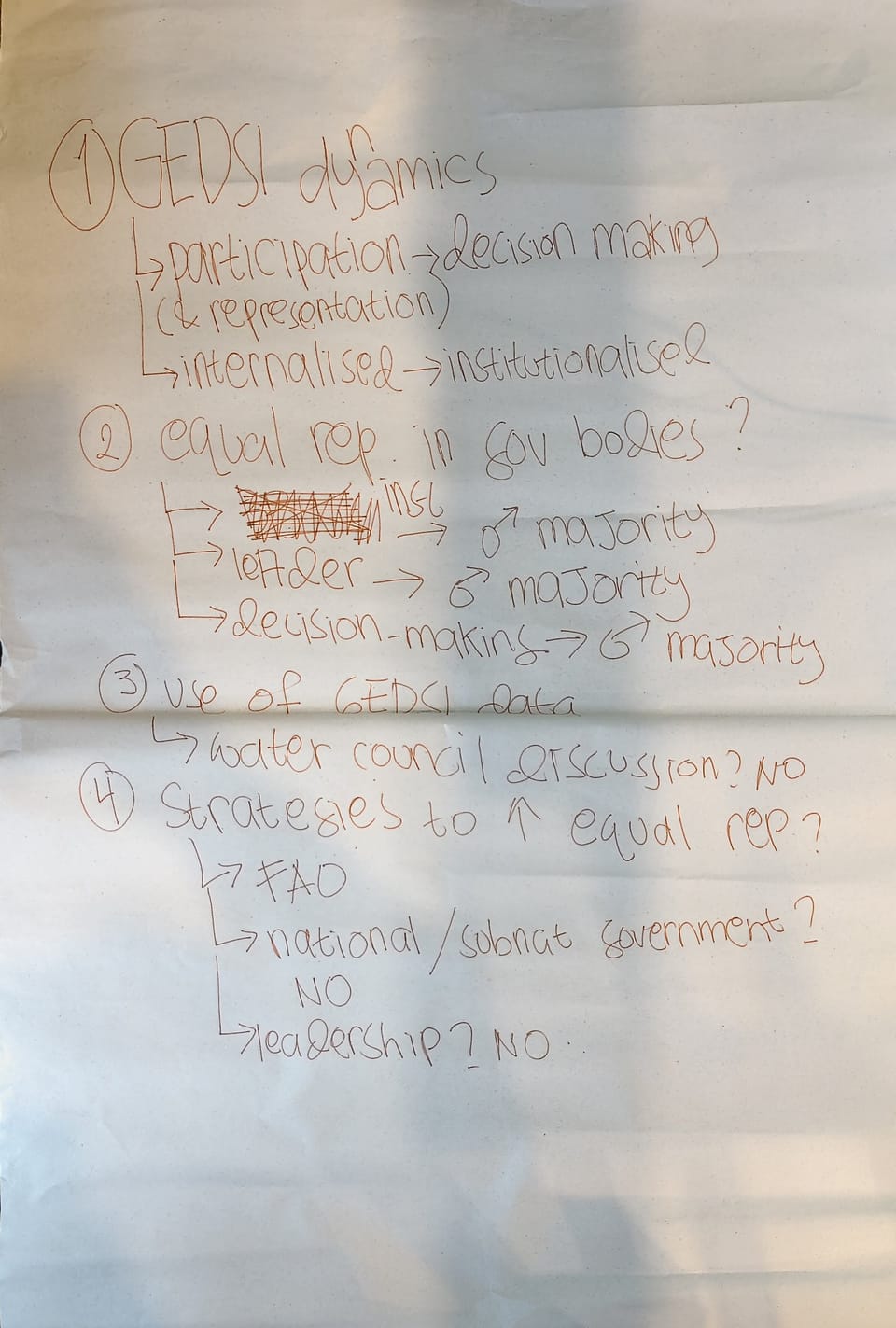
The strongest correction came from a Bappeda Yogyakarta participant, who held the line through several rounds of discussion: equity in the water sector is not only about gender. There are three dimensions, and they have to travel together. Poverty determines whether a household can afford a piped connection from the local water utility (PDAM) or has to depend on a shallow well. Disability determines whether a wheelchair user can reach a communal water source at all. Both of these dimensions rarely show up in conventional gender-indicator forms.
"Equity isn't only gender — it's also poverty and disability. There are three of them." — paraphrased, Bappeda DI Yogyakarta participant
The room then offered a finding that surprised the international partners. In several local water forums in Yogyakarta — including the P3A, the formal water-user farmers' associations — it is not men who dominate but women. Women are also strongly represented as water-environment advocates in the province. The conventional assumption that gender is the binding constraint in every Indonesian basin, in other words, does not survive a careful look at DI Yogyakarta. Participants from other regions confirmed the inverse pattern: in their districts, formal P3A invitations are still mostly answered by men. The lesson is that geographic variation has to be mapped, not assumed.
This is where the project's GEDSI partner, the Institute for Sustainable Futures at UTS, introduced its working framework: a four-step spectrum from insensitive to sensitive, responsive, and finally transformative. The team agreed on the transformative end as the project's aspiration — explicit work on the power norms that shape who controls water, support for women's leadership in basin governance, and policy change that reshapes who sits at allocation tables. Sub-national participants accepted the framing; they also added a practical caveat. Transformative work needs grounded data, and grounded data needs the right partner.
That partner was named several times in the discussion: DP3AP2, the Office for Women's Empowerment, Child Protection, and Population Control. DP3AP2 already maintains a reporting template for inclusion indicators in both DIY and Central Java. The participants' point was direct: the project should not start from zero. It should adopt the existing template, harmonise its data fields with DP3AP2's, and let the office do what it already does — except now in conversation with the project's water-allocation outputs.
The second concrete recommendation was to vary the format of consultation. Big plenary forums are useful for visibility, but they are not where minority voices speak first. Sub-national participants asked the project to schedule what they called small rooms: village-level focus group discussions with four or five participants, in local language, at times that work for women, smallholders, and people with disabilities. The basin's social capital makes this a feasible ambition. The project starts with eight IP3A federations, sixteen GP3A federations, and 474 P3A groups already in place.
One further note carried weight. The TU Delft-led research at the Brantas basin has already documented the way that village-level Musrenbang processes can become symbolic — with women invited as administrative compliance rather than as meaningful participants. The Serayu-Opak project has been asked to take that as a warning. Symbolic participation is worse than no participation: it offers institutional cover for decisions that have already been made.
What the project commits to, on the basis of these inputs, is laid out in its desktop institutional analysis (CRPG, due September 2026) and in the GEDSI baseline plan led by ISF-UTS. The core operational decision is the simplest one. Inclusion will not be added at the end of a model. It will be designed in from the first dataset.