From water balance to water accounting: a subtle but substantive shift
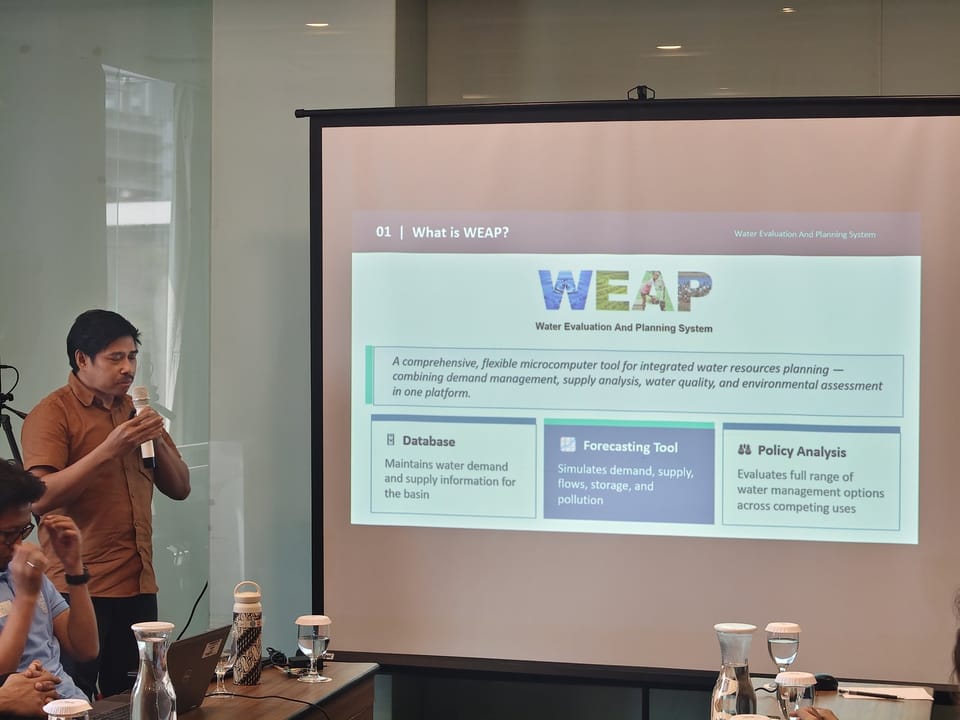
One of the more clarifying exchanges of the workshop happened when the research team turned to sub-national participants and asked, plainly, whether they had ever discussed water accounting internally. The answer was honest: never. Not yet. But water balance — we already do that here.
The distinction between the two terms is the methodological centre of the project, and it deserves to be drawn carefully. Water balance is a familiar exercise. For a region or a basin and a defined time period — a year, a season — the calculation tracks how much water comes in (rainfall, river inflows) against how much goes out (consumption, evaporation, outflow). The results are useful for high-level planning and have been routinely produced by Balai and Dinas offices for decades. They are the basis of the allocation conversations that already happen.
Water accounting is more detailed and more dynamic. It traces the process by which surface water becomes groundwater, returns as runoff, and moves through specific aquifer capacities. It separates withdrawals from consumption. It distinguishes water rights from water actually allocated and from water actually extracted. It can also include the trade and reallocation of those rights, where they exist. And it produces accounts that can be opened up — read, audited, and questioned by anyone who needs to know what is happening in the basin.
The CSIRO team brought a working reference to the discussion. Australia's National Water Accounts are produced annually for each water year (July to June) by hydrological unit. The reports cover inflows, outflows, and changes in storage; they capture water-access entitlements, water-management plans, and the relationships among allocation, extraction, trading, and environmental water. The Murray-Darling Basin Plan 2012 set long-term sustainable diversion limits for twenty-nine surface water units and eighty groundwater units — limits that took years of contested public consultation to settle but are now an operational reality.
None of this is being imported wholesale. The Australian system was built for a national geography, a legal regime, and a political economy that are not Indonesia's, and the workshop did not pretend otherwise. The Australian reference functions as a comparator — a well-documented account of what an integrated framework can look like at scale — against which Indonesia's needs can be calibrated. The project's task is the opposite of imitation. It is contextualisation.
What contextualisation looks like, in practice, became clearer over the course of the workshop. The Indonesian water-accounting framework will need to integrate surface water, groundwater, and rainwater. It will need to make explicit the role of each agency that owns part of the data. It will need to handle variation across institutional jurisdictions — central, provincial, regency — and across planning cycles that do not align. It will need to account for unrecorded abstraction, particularly by small and medium industries operating without formal SIPA permits. And it will need to use the language of Indonesian policy: the National Water Security Index (IKAN), the Water Quality Index (IKA), the Five SDA Pillars under Law 17/2019, the Food–Energy–Water Nexus.
The connecting bridge between water balance and water accounting is the existing monitoring infrastructure. The Yogyakarta-Sleman groundwater basin already operates approximately fifty-four monitoring wells, mostly for water-table measurement, with samples taken for water-quality assessment. Most wells remain in good condition. Linking that network to the new framework — rather than designing a parallel system — is one of the project's most concrete technical commitments. The point is not to discard the work that basin agencies have been doing. It is to extend it.
One more methodological note from the workshop is worth preserving. The breakout groups in the Vision-Challenges-Opportunities session named data fragmentation as the top barrier across all six tables. They also named, as one of the top quick-win opportunities, an open-data dashboard pilot for Serayu-Opak as a test-bed for the wider Indonesian rollout. The methodological work is therefore inseparable from the data-governance work covered in an earlier post in this series. A water-accounting framework that runs on data nobody else can see is not really a water-accounting framework. It is a model.