

Mundur–Madhep–Munggah: a Yogyakarta approach to living with rivers
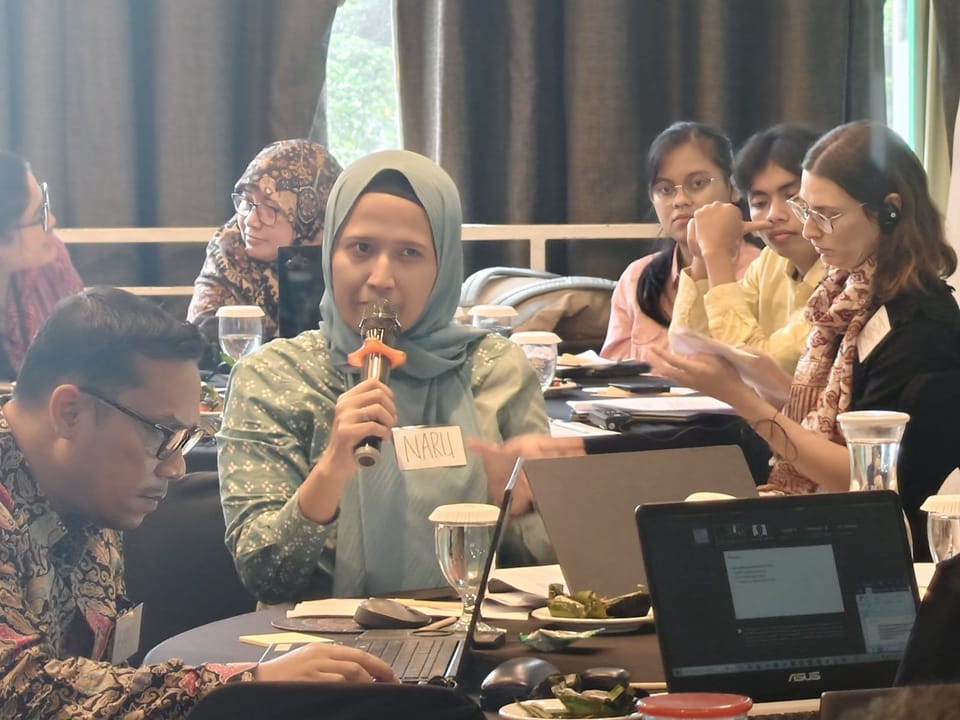
It would have been easy to miss. In the middle of a long discussion about authority, data, and modelling, a Yogyakarta participant raised a hand and offered a different kind of contribution. He described a hybrid traditional-modern practice already operating along the Code, Winongo, and Gajah Wong rivers in the Yogyakarta urban area — a way of organising the relationship between houses and rivers that is neither folklore nor decoration. It has a name, three Javanese words, and a clear set of rules.
Mundur means to step back. In the practice along the Code, Winongo, and Gajah Wong, this translates into a building-setback rule. The convention is a setback of three metres from the riverbank — small enough to be enforceable, large enough to keep the river's edge as a continuous ecological corridor rather than as the back wall of someone's kitchen. It is unfussy. It is workable.
Madhep — sometimes phrased as Ngajep Kali — means to face the river. This is the more interesting rule, because it operates on orientation rather than distance. Houses are oriented so that the river is the front yard rather than the back. The cultural effect is significant: a river that you face is a river you maintain. A river you turn your back to becomes a place where waste, drainage, and unconsidered runoff end up. The geometry shapes the relationship.
Munggah means to step up, or to elevate. When household resources allow, riverside houses raise their floor — anticipating flooding rather than denying it. The practice does not require expensive engineering. It is incremental, undertaken when families can afford it, and locally adapted to the height patterns of each river's seasonal variation.
| Concept (Javanese) | Meaning | Concrete implementation |
|---|---|---|
| Mundur | Step back from the river | Building-setback rule, typically 3 m from the riverbank |
| Madhep (Ngajep Kali) | Face the river | House orientation that turns the river into a "front yard" |
| Munggah | Step up / elevate | Riverside house floors raised when household resources allow |
What is striking about this offering — and the reason it landed in the workshop — is that it solves three problems that international water-governance frameworks usually treat separately. Mundur addresses riparian buffer zones. Madhep addresses social attitudes towards water bodies. Munggah addresses flood adaptation at the household scale. In conventional planning documents, these are three different chapters with three different consultants. In Yogyakarta, they are three Javanese verbs that fit on one slide.
The project has been asked to integrate the approach into its recommendations — not as folklore appended to a final report, but as a tested spatial-planning method that already operates in living urban communities. There is a real opportunity here. International water-accounting frameworks are typically thin on cultural infrastructure; they treat human behaviour as either an input variable or a compliance problem. Indonesia has practices that go further. They embed the right behaviour in the orientation of a building.
The project's GEDSI lead and the institutional-analysis team have noted the contribution. The path forward is straightforward in principle and demanding in practice: document the rule set, identify which provincial and district regulations already incorporate elements of Mundur-Madhep-Munggah, identify which do not, and propose a path by which the spatial-planning instruments at the regency and city level can adopt the rules where they are absent. None of this requires the project to invent anything. It requires the project to listen carefully and write clearly.
The contribution is also a quiet correction to a habit that international research can fall into — the assumption that integration of local knowledge means citing a community practice in a footnote and proceeding with the standard model. The workshop heard a different proposition. Mundur-Madhep-Munggah is not a footnote. It is a working policy. It belongs in the body of the recommendation.