CRPG co-hosts inception workshop on water accounting for Indonesia
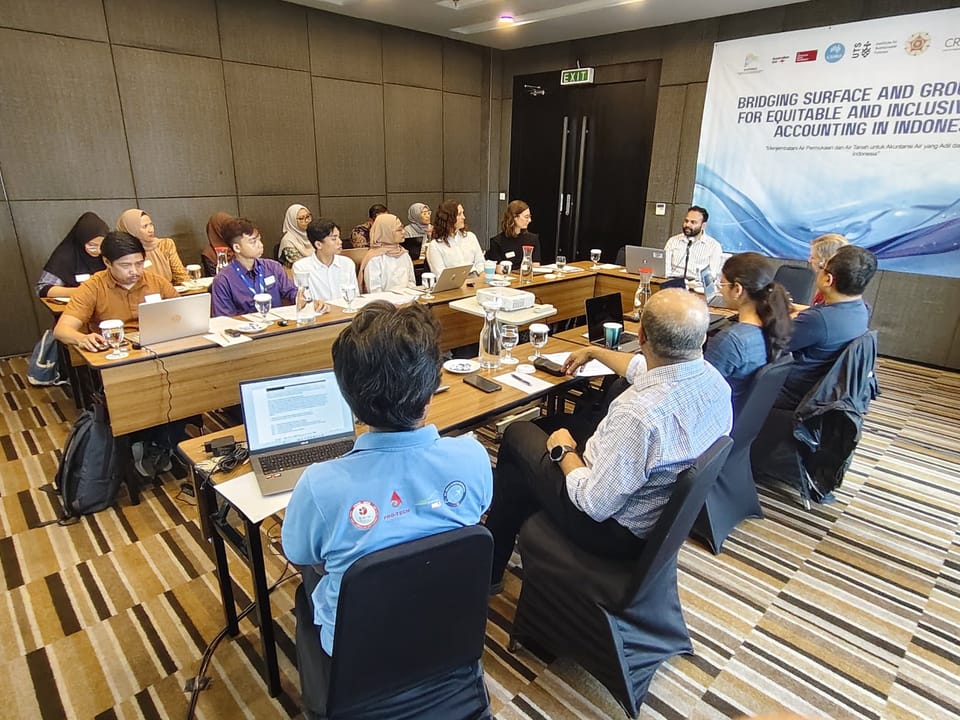
The Center for Regulation, Policy and Governance (CRPG) co-hosted the inception workshop of Bridging Surface and Groundwater for Equitable and Inclusive Water Accounting in Indonesia at Akmani Hotel Jakarta on 4–5 May 2026. The two-day meeting opened a research project that will pilot an integrated water accounting framework in the Serayu and Opak river basins of Central Java and the Special Region of Yogyakarta.
The workshop was convened jointly by the Ministry of National Development Planning (Bappenas), the Australian Water Partnership (AWP) under DFAT, the Commonwealth Scientific and Industrial Research Organisation (CSIRO), the Institute for Sustainable Futures at the University of Technology Sydney (ISF-UTS), Universitas Gadjah Mada (UGM), Institut Pertanian Bogor (IPB), and CRPG. The project is positioned as a pilot for Indonesia's national water accounting rollout, anchored in Bappenas's Water Self-Sufficiency priority under the 2025–2029 medium-term development plan (RPJMN).
Around 45 participants attended Day 2, the multi-stakeholder session: officials from Bappenas, the Ministry of Energy and Mineral Resources (MEMR) Geological Agency, the Ministry of Environment, Bappeda DI Yogyakarta, the Public Works Office of Central Java Province, and academics from UGM and IPB, alongside the Indonesian and Australian project teams. Day 1 was a closed working session for the project consortium to finalise the technical framework and align on the role of each partner.
Several anchors framed the conversation. From Bappenas: Indonesia manages nearly 8,000 watersheds within 131 river basin territories; water demand is projected to rise 31 percent by mid-century; and more than half of national GDP in 2045 is expected to come from basins that already face dry-season scarcity. From the Balai Besar Wilayah Sungai Serayu-Opak (BBWS-SO): the pilot basin covers 12,370 km², holds an estimated 851 springs, and supports 15.22 million people across two provinces and fifteen regencies and cities.
The workshop was deliberately structured to listen more than speak. Each institution was given four to five minutes in an open-mic round to introduce its position; six breakout groups worked through the project's vision, GEDSI priorities, and impact-pathway assumptions; and a quick plenary vote opened a conversation about the project's short name. Phrases like inclusive allocation and equitable water accounting drew strong support from participants, with final results to be circulated by the consortium in the coming weeks.
One framing remark from a participant stayed with the room. Project success, the participant said, is not a beautiful technical model that nobody opens. It is a government and a basin community that take the work seriously enough to use it. That benchmark, agreed at the start, will guide the project's design choices across the next three years.
The CRPG team thanks all participants for attending, and Bappenas, AWP, CSIRO, ISF-UTS, UGM, and IPB for co-hosting. A series of follow-up posts on this site will explore in more depth the themes that emerged: the triad of inclusion, the politics of cross-agency data, the pressure on springs in the Progo sub-basin, fragmented water authority, the local wisdom of Mundur-Madhep-Munggah, and the practical difference between water balance and water accounting.