From RPJMN to river basins: how "water self-sufficiency" anchors the Serayu-Opak pilot
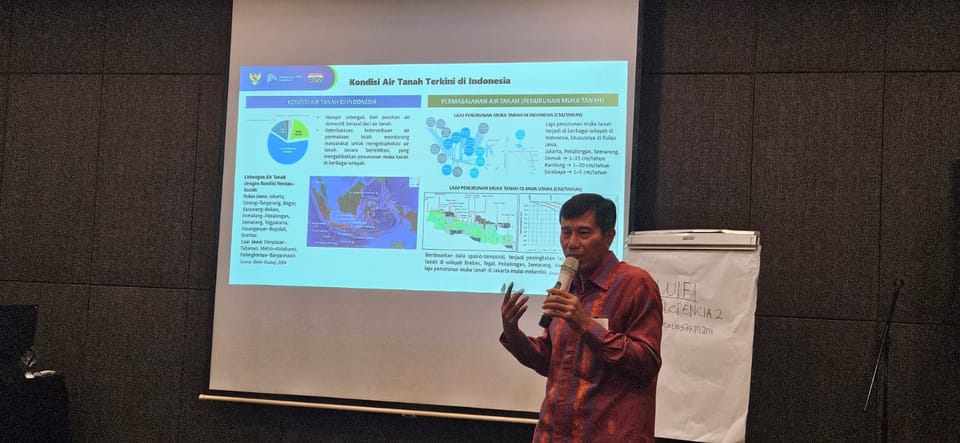
The Day 2 keynote, delivered by Bappenas's Directorate of Water Resources, did the work of placing the project inside Indonesia's policy architecture. The slide deck circulated quietly during introductions, but its numbers became the day's discussion anchors.
The first set of figures concerns the gap between availability and demand. Indonesia manages nearly 8,000 watersheds within 131 river basin territories. National groundwater potential is estimated at around 520 billion cubic metres a year; the safe-yield share, at 30 percent, is roughly 155 billion cubic metres. Against that, water demand is projected to rise 31 percent — from 3,333 to 4,864 million cubic metres a year — driven by population and economic growth. Industrial demand alone is expected to quadruple, while average annual raw-water capacity grows by only two cubic metres per second.
The second set is about economic exposure. By 2045, more than half of Indonesia's GDP is expected to come from river basins that already face dry-season water scarcity. Without intervention, the World Bank estimates a 2.5 percent GDP decline by mid-century from water shortage alone, and an additional 1.42 percent from groundwater over-extraction — a polite way of saying land subsidence, seawater intrusion, and rising flood vulnerability.
The third concerns quality. The national Water Quality Index has crept from 53.53 in 2020 to 54.78 in 2024, drawn from more than 7,000 sampling points. But ninety-three percent of groundwater samples exceed pollutant thresholds, and seventy percent of that pollution comes from leaking septic tanks and untreated wastewater discharged into drainage. In Jakarta, more than eighty percent of well water now fails quality standards; microplastics have been detected, alongside the heavy-metal load familiar to industrial-zone monitoring.
These numbers feed into a policy frame that is by now familiar inside government but less so to general audiences. Under the 2025–2045 long-term development plan (RPJPN) and the 2025–2029 medium-term plan (RPJMN), Water Self-Sufficiency is named as Priority Programme 12 within the broader National Priority of food, energy, and water self-sufficiency. Four flagship priority activities sit underneath: developing and managing water storage; providing sustainable water supply; managing water-related disaster risk; and integrated North Java Coast development. The Food–Energy–Water Nexus is the cross-sectoral anchor.
This is the policy chassis the project is being asked to slot into. For the Serayu-Opak pilot, three implications emerged in discussion. First, the project's outputs need to speak the language of Bappenas's IKAN — the National Water Security Index — and not only the Water Quality Index that sub-national agencies are more familiar with. Second, the analytical horizon should reach beyond the next medium-term plan: anchoring recommendations in the next RPJMN cycle (2030–2034) is, in the words of one participant, the only way to keep the work alive after the project closes. Third, the pilot's policy reach must be calibrated to a national plan that is structurally consolidating: 128 river-basin territories are being reorganised to 124, with 64 of them moving to direct central authority.
The basin selected for the pilot reflects this layered policy reality. WS Serayu Bogowonto holds National Strategic status; WS Progo Opak Serang holds Cross-Province status because it spans Central Java and DI Yogyakarta. Both are likely to fall within the 64 central-authority basins, but the precise criteria and budget implications for sub-national planning still await formal clarification.
Bappenas's framing made one thing explicit. It is being asked to demonstrate, in one basin, a way of accounting for water that the rest of Indonesia's basins can adopt. Whether that demonstration succeeds will be measured less by the elegance of the model and more by whether the next planning cycle picks it up.