A permit is not consent: Why water tenure is now a legal exposure
A permit is not consent
A water permit tells you a company is allowed to take water. It tells you nothing about who else has a claim on it. That gap is now a legal exposure.
The customary irrigator downstream, the religious institution that holds the spring, the ecosystem whose flows underpin the fishery — none appear on a permit register. Yet mandatory due-diligence law across the EU, Germany, France, Norway, the UK and Australia already requires companies to see them, identify adverse impacts, and provide remedy. The analytical lens that makes this possible is water tenure. That was the argument our Director, Mohamad Mova Al'Afghani, brought to Bangkok.
Why FAO convened Bangkok
The FAO Regional Dialogue on Water Tenure for Asia and the Pacific took place on 6–7 May 2026, organised under the ScaleWat programme with the Government of Germany, in collaboration with the Office of the National Water Resources of Thailand (ONWR Thailand) and the Asia-Pacific Rural and Agricultural Credit Association (APRACA). The event is part of FAO's broader work programme on responsible water-tenure governance.
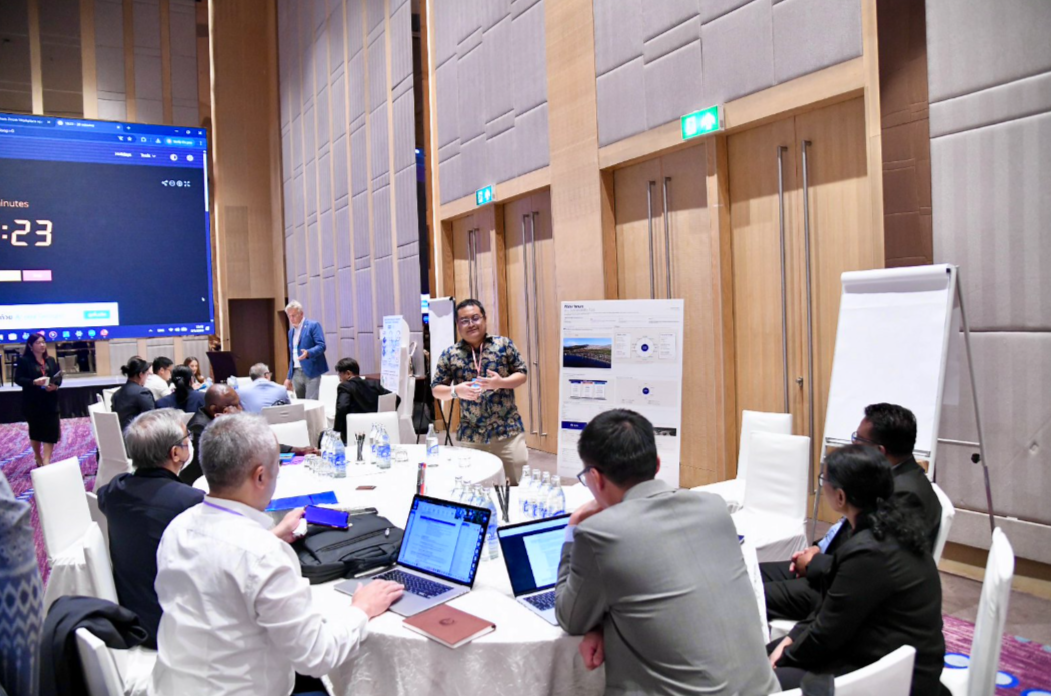
The dialogue used a World Café format: small groups rotated through poster stations in 25-minute rounds. Our Director's poster, "Water Tenure as a Sustainability Tool," was assigned to the group on water tenure and corporate responsibility. The Asia-Pacific focus was deliberate. The region hosts high concentration of customary, communal and Indigenous water tenure systems.
The missing lens
Most corporate due-diligence and ESG-disclosure systems define water entitlements legally and volumetrically: licence holders, abstraction permits, discharge consents. This frame is not wrong — it is simply incomplete.
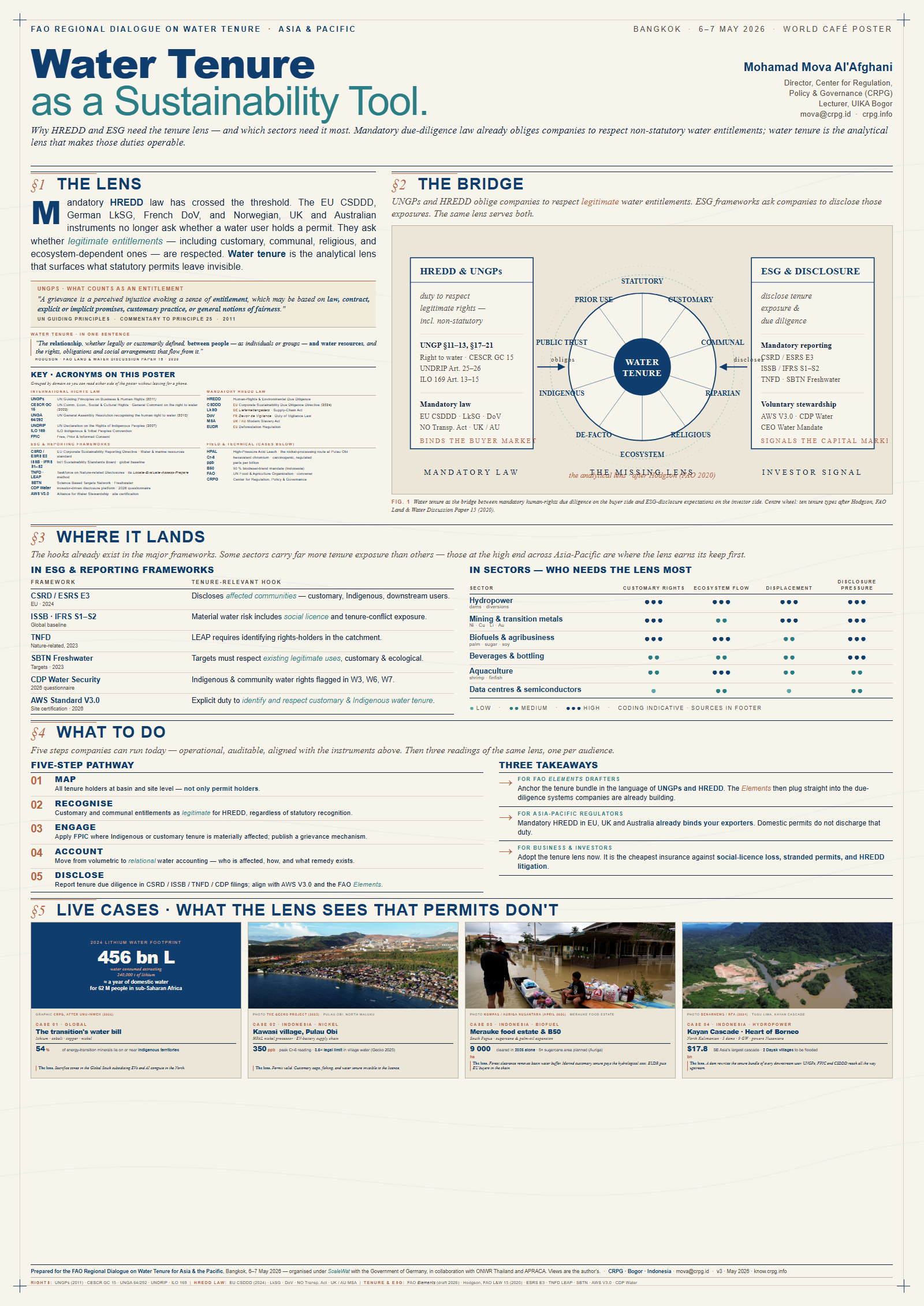
Statutory permits cover only a fraction of actual water users across Asia-Pacific. The remainder hold water through customary practice, religious institutions, de-facto historical use, ecological dependence, and riparian or prior-use claims that domestic law may not formally record. FAO Land and Water Discussion Paper 15 (Hodgson, 2020) catalogues ten categories of entitlement: statutory, customary, communal, riparian, religious, ecosystem, de-facto, Indigenous, public trust, and prior use.
Water tenure is the analytical concept that names all. Hodgson defines it as "the relationship, whether legally or customarily defined, between people — as individuals or groups — and water resources, and the rights, obligations and social arrangements that flow from it." Tenure is not a binary. It is a set of overlapping, sometimes competing, claims. Human Rights and Environmental Due Diligence (HREDD) law now requires companies to work through the whole bundle, not only the statutory top layer.
Mandatory law has crossed the threshold
The original anchor is the UN Guiding Principles on Business and Human Rights (UNGPs, 2011), which establish the corporate responsibility to respect all internationally recognised human rights — including the human right to water, affirmed by UNGA Resolution 64/292 (2010) and elaborated in the Committee on Economic, Social and Cultural Rights' General Comment 15 (CESCR GC15, 2002). The UNGPs note that a legitimate grievance may be based on "customary practice, or general notions of fairness." Customary water entitlements are legally relevant under that framing even where domestic statute is silent.
What changed the calculus for business is that voluntary principles became mandatory law. The French Devoir de Vigilance (DoV, 2017) was the first national law to impose a legally enforceable human-rights vigilance duty on large companies. Germany's Lieferkettengesetz (LkSG), the Supply Chain Act adopted in 2021 and in force since 2023, explicitly references the human right to clean water. The EU Corporate Sustainability Due Diligence Directive (CSDDD, 2024) extends mandatory HREDD across the EU single market and its supply chains. Norway's Transparency Act (2022), the UK Modern Slavery Act (MSA, 2015) and the Australian Modern Slavery Act (MSA, 2018) complete the picture in major buyer markets.
None of these instruments limit their inquiry to whether a company holds a water permit. They ask whether legitimate entitlements — including non-statutory ones — are respected. A company can be fully permitted under national water law and still face HREDD liability in EU buyer-market courts — Paris under the Devoir de Vigilance, and civil jurisdictions in Germany and the Netherlands under LkSG and CSDDD — if customary, communal or ecosystem entitlements were ignored. The EU Deforestation Regulation (EUDR, 2023) adds buyer-side liability for commodities linked to deforestation, which almost always occurs in catchments where customary tenure is the primary governance mechanism.
ESG frameworks converge from the disclosure side
While mandatory law binds buyers through supply chains, ESG disclosure frameworks are signalling the same requirement to capital markets from the disclosure side. The message in each case is consistent: identify who else your water use touches, including users who hold no statutory permit.
The EU Corporate Sustainability Reporting Directive (CSRD), implemented through the European Sustainability Reporting Standards water topical standard (ESRS E3), requires disclosure of "affected communities" — explicitly including customary, Indigenous and downstream users. The International Sustainability Standards Board's global baseline (ISSB, IFRS S1–S2) treats social-licence risk and tenure-conflict exposure as financially material water risks. The Taskforce on Nature-related Financial Disclosures (TNFD) Locate-Evaluate-Assess-Prepare (LEAP) method (2023) requires identification of rights-holders across the catchment, not only at the site boundary. The Science Based Targets Network (SBTN) Freshwater targets (2023) require that reduction targets respect existing legitimate uses — customary and ecological as well as statutory.
Alliance for Water Stewardship (AWS) Standard V3.0, launched in March 2026, strengthens requirements to identify affected water users — including customary and Indigenous tenure holders — in catchments where AWS-certified sites operate. The hooks already exist across all the major frameworks. What has been missing is the analytical lens to make them operable: water tenure.
The global lithium water bill
The fourth case is not a single site but a structural condition. UNU-INWEH (UN University Institute for Water, Environment and Health) estimates published in 2026 indicate that producing the 240,000 tonnes of lithium extracted globally in 2024 consumed roughly 456 billion litres of water — comparable to the annual domestic water supply of approximately 62 million people in sub-Saharan Africa. Studies indicate that roughly half of energy-transition minerals are sourced on or near Indigenous territories, a significant share of which lie in high-water-stress catchments.
EVs, grid-scale batteries and AI computing infrastructure are partly subsidised by the uncompensated sacrifice of customary water tenure in the Global South — a material HREDD exposure for manufacturers, investors and financiers across those supply chains.
The sectors most exposed
The poster maps exposure across eight sectors identified as the heaviest users of water in Asia-Pacific and most likely to encounter non-statutory tenure in their operational catchments.
Hydropower carries maximum exposure on all four dimensions — customary rights conflict, ecosystem-flow disruption, community displacement and disclosure pressure — because dams physically transform the tenure bundle of every downstream user. Mining and transition-mineral processing (nickel, copper, lithium, gold) lead on customary-rights conflict and displacement risk; extraction commonly occurs in Indigenous territories, and investor scrutiny is intense. Biofuels and agribusiness (palm, sugarcane, soy) carry high exposure on customary rights and ecosystem flows, with EUDR adding acute traceability pressure. Beverages and bottling lead on disclosure pressure relative to customary-rights exposure, positioned by AWS-aligned corporate water-stewardship programmes as test cases. Aquaculture, particularly coastal shrimp farming, collides directly with communal fisher tenure in mangrove commons. Pulp and paper plantations alter hydrology across entire sub-catchments. Apparel wet-processing generates discharge that degrades downstream tenure even where withdrawal volumes are permitted. Data centres and semiconductors are an emerging frontier: hyperscale cooling in groundwater-stressed locations is attracting growing CSRD and ISSB scrutiny.
A five-step pathway for companies
The poster concludes with an operational pathway companies can implement within existing HREDD and ESG systems, without waiting for new regulation.
- Map all tenure holders at basin and site level — statutory, customary, communal, religious, de-facto and ecosystem — not only permit holders.
- Recognise customary and communal entitlements as legitimate for HREDD purposes, regardless of statutory status under domestic law. The UNGPs' commentary to Principle 12 extends the corporate responsibility to rights recognised under UNDRIP and ILO 169, even where national law has not yet incorporated them.
- Engage with affected rights-holders. Where Indigenous or customary tenure is materially affected, apply FPIC as a process standard. Publish an operational grievance mechanism accessible to non-statutory tenure holders.
- Account relationally, not volumetrically. Track who is affected, how their tenure is altered, and what remedy is owed — not only litres abstracted. This is relational water accounting: a shift in logic, not merely a data exercise.
- Disclose tenure due-diligence findings in CSRD/ESRS E3, ISSB and TNFD filings, and align with AWS V3.0.
What this means for the room in Bangkok
For Asia-Pacific regulators, the key message is jurisdictional: domestic permits do not, on their own, discharge HREDD duties. A company fully compliant with Indonesian, Thai or Philippine water law can still face enforcement action in a European buyer-market jurisdiction if customary, communal or ecosystem entitlements were ignored. Building basin-level platforms that formally record non-statutory tenure — with binding legal effect — converts water-tenure recognition from an externally imposed HREDD obligation into a domestic governance asset.
For business and investors, the tenure lens is not a compliance burden added to existing ESG systems. AWS V3.0, TNFD LEAP, SBTN Freshwater and ESRS E3 already contain the hooks. What is missing is the field-level mapping that populates those hooks with actual rights-holders. That mapping is cheaper than social-licence loss, stranded permits or HREDD litigation. Treat the voluntary stewardship frameworks as floors, not ceilings, and adopt relational water accounting now.
For FAO, the ongoing work programme on responsible water-tenure governance should anchor the corporate-actor pieces explicitly in UNGPs and HREDD language. Doing so allows companies to map FAO guidance directly onto the due-diligence systems they are already building — minimising translation cost and maximising uptake.
References
International rights law
- UN Guiding Principles on Business and Human Rights (UNGPs), Principles 11–21 (2011)
- CESCR General Comment 15 on the Right to Water (2002)
- UNGA Resolution 64/292, Human Right to Safe Drinking Water and Sanitation (2010)
- UN Declaration on the Rights of Indigenous Peoples (UNDRIP), Art. 25–26, 32 (2007)
- ILO Convention No. 169 on Indigenous and Tribal Peoples, Art. 13–15 (1989)
Mandatory HREDD law
- EU Corporate Sustainability Due Diligence Directive (CSDDD) (2024)
- German Lieferkettengesetz (LkSG) (adopted 2021, in force 2023)
- French Loi relative au devoir de vigilance (Devoir de Vigilance / DoV) (2017)
- Norwegian Transparency Act (Åpenhetsloven) (2022)
- UK Modern Slavery Act (MSA) (2015)
- Australian Modern Slavery Act (MSA) (2018)
- EU Deforestation Regulation (EUDR) (2023)
ESG and disclosure frameworks
- CSRD / ESRS E3 (EU Corporate Sustainability Reporting Directive — water and marine resources topical standard)
- ISSB / IFRS S1–S2 (International Sustainability Standards Board global baseline)
- TNFD LEAP framework (Taskforce on Nature-related Financial Disclosures, 2023)
- SBTN Freshwater targets (Science Based Targets Network, 2023)
- AWS Standard V3.0 (Alliance for Water Stewardship, March 2026)
Water tenure scholarship
- Hodgson, S. (2020). Water tenure: Setting the scene. FAO Land and Water Discussion Paper 15. Rome: FAO.
Case sources
- The Gecko Project (2025). Investigation into hexavalent chromium contamination at Kawasi village, Pulau Obi, North Maluku.
- Auriga Nusantara (April 2026). Merauke food-estate expansion and deforestation findings.
- Nunbogu, A. M., Farsi, M., Matin, N., & Madani, K. (2026). Critical Minerals, Water Insecurity and Injustice. Hamilton: United Nations University Institute for Water, Environment and Health (UNU-INWEH).
- Owen, J. R., Kemp, D., Lechner, A. M., Harris, J., Zhang, R., & Lèbre, É. (2023). Energy transition minerals and their intersection with land-connected peoples. Nature Sustainability, 6(2), 203–211.